Sonic the Hedgehog is perhaps one of the most memorable and exciting games in console gaming history. As we’ve looked at the best Megaman Hacks before, I thought why not take a look at some of the amazing Sonic the Hedgehog hacks that are out there. These are just a few of the many great hacks out there for Genesis and other classic consoles. There’s even a 8-bit NES Sonic in the list!
You can grab a Sega emulator and get any of these games up and running without messing with patches or anything like that. I won’t go into Emulators too much here, but I do recommend Gens/GS if you don’t know where to start.
In the 2000’s there were a number of Sonic hacking/remake contests. Most of these games are winners or runners up from that awesome contest. You can find lots of info on these and other hacks over at sonicretro.org.
If you haven’t heard of The Flight Away, you need to get their amazing EP “If I Could Reach the Sky”, an awesome emotronic album that blends sunny emo vocals and guitars with classic 16-bit and 8-bit tones and basslines. Not content to just create the same sound over and over, The Flight Away’s newest release, SEGA Swing is a bit of a departure from the sounds of If I Could Reach The Sky.
Music in the late 80’s and early 90’s (pre-grunge) had a very distinct sound. Those big gated drums and synthetic baselines and synth pianos just scream ending credits of an 80’s teen movie. The SEGA Swing album aims to capture some of this sound. The entire album is made up of instruments ripped straight from Sega Genesis soundtracks as well as drums that mimic the style of the era. It’s a double dose of nostalgia with the song style and the sounds from the 16-bit console of the era.
It’s not the most commonly imitated time period, but I think we’ve reached the point where it can be enjoyed in a nostalgic way. The romantic and pop-infused tracks of SEGA Swing will remind you of everything from New Order to Michael Jackson to EMF. It sounds weird but it also reminds me of Toad the Wet Sprocket. Total 90’s new jack swing styled thing going on throughout it. Also Dance Fight is a somewhat hilarious bonus track that reminds me of Haddaway and Night at the Roxbury.
The stand out tracks in my opinion are The Endless Loop and I Can’t Take (This Feeling), which emulate everything that was amazing about New Order in the 1980s. There’s not a bad song on here and it still feels like something by The Flight Away, not some huge digression from their core style. Grab it today!
Beatscribe is a full time indie composer, musician and writer. By day he creates soundtracks and sfx for various mobile gaming companies, by night creates megaman-inspired chiptunes, in the afternoons he drinks tea. Check out his latest releases, tutorials and retro ruminations at www.beatscribe.com.
Today, we’re looking at three classic 8/16-bit games that have two things in common. One, they all feature awesome robots and two, they’re highly underappreciated. These games also feature some effects and gameplay ideas that were far ahead of their time. In fact, one of these games is part of the legacy from an amazing studio that’s just closed down. If you’re looking for some new ROMs to try out, these three are highly recommended.
Metal Storm
NES – Irem 1991
If you’ve ever played this boss battle with no save-state, you have known true terror.
Metal Storm is a high-quality platformmer game in the vein of Mega Man or Metroid but with awesome twist; your mech can reverse his gravity and fly up to the roof at any moment. Some of the baddies can do it too, which keeps things interesting. The level design is brilliant: Can’t pass that huge pit? Why not reverse gravity and walk across the ceiling? You can even sort of hover temporarily by continually switching the gravity. You’ll have to master switching orientation quickly in the later stages to latch onto tiny platforms or even bosses in some instances.
Metal Storm is the earliest console game (and only NES one) I’ve ever seen that has parallax scrolling. The programmers constantly redrew the background to create that effect that was much more common in 16-bit systems. It really gave the world a level of depth.
Oh yeah, this game also has THE MOST INSANE BOSS FIGHT EVER. Just click the link and watch the video. I don’t think I ever sweated so much during a gaming session as when playing it on the actual console. Every boss in the game is brilliantly designed. The gravity-switch is not just a gimmick, it’s the very foundation of the gameplay.
Herzog Zwei
Sega Master / Genesis – Technosoft 1989
Herzog’s split-screen two player mode is the grandaddy of things like Starcraft.
Dune II is often credited as the first RTS game, but a little Mega Drive cart called Herzog Zwei beat them to the genre by a full two years! This is possibly one of the best 2-player games on the Genesis. The split screen interface is at times annoying and gives away what’s going on, but there were NO GAMES like this at that time. At least play this to pay respect to the forerunner that gave us things like Starcraft.
This game is kind of a micromanagement nightmare at its worse but it’s great strategy and exciting action at its best. You can spawn up to 50 units per player and launch all sorts of attacks against your robot opponent’s base. The AI is not so great, so play this one with a friend.
Metal Warriors
SNES – LucasArts 1995
The two-player VS mode is possible the most fun you can have on the SNES.
Imagine taking the Megaman X or Metroid game engine and making it a 2-player hunt fest. Or if you prefer, a 1 player awesome mission-driven game. That’s what this very anime-influenced game brings to the table. The 1-player mode is great, you drive around in big bulky mechs, taking out other big bulky mechs. Occasionally, you have to get out and go hack a computer as a tiny vulnerable human, and hope someone doesn’t steal your vehicle while you’re out. With 6 different Mechs to chose from and the ability – and often necessity – to switch them three or four times per level, the gameplay is truly dynamic.
The thing that stands out the most in this game is that no one Mech suit can destroy the others easily. There is no ‘best suit’. Each suit stands a fair fight against another suit in the hands of an experienced player who knows how to use them. I always loved the lumbering Prometheus. This dude has NO JUMP, that’s right, he cannot leave the ground, but he has insane armor, attacks that can deal serious damage across the entire map, and he can even build bridges to cross gaps or seal off portions of the board. You have to carefully select which suit you’ll use in the Mission mode, since there are lots of suits laying around, often just as a tease to get you to trade. The missions often depend on having the right suit at the right moment and knowing when to ditch your smoking wreck as well. The one-player mode is full of challenges and interesting twists that keep you excited about the otherwise mundane story.
Each suit has pros and cons and no one suit can overpower the others.
However, all this pales in comparison to the funnest two-player mode on any SNES game in existence. In split-screen mode, you go out to find and destroy your friend’s mech. It’s a great game of cat and mouse, especially when one of you loses your suit and has to hunt down a spare while being chased by a massive mech. With tons of powerups and suits that fly, cloak, climb walls, sonic-the-hedgehog-dash, build bridges, swing chains and uh..sort..of..jet-ice-skate along (?), it’s tons of fun with the most replay imaginable.
Why did none of these games get the attention they deserve? I really can’t say. Bad timing, poor advertising, saturated market? The good thing is, these games age quite well. Try them out today.
Beatscribe is a full time indie composer, musician and writer. By day he creates soundtracks for various mobile gaming companies, by night creates megaman-inspired chiptunes, in the afternoons he drinks tea. Check out his latest releases, tutorials and retro ruminations at www.beatscribe.com.
I have really fond memories of the Sega Genesis system, which is strange because we were a humble, middle-class one-console (SNES) family and I only played it at the neighbor kid’s house. I have fond memories of playing Herzog Zwei and eating pizza all night in my friend’s dank basement. Lately, I’ve been wanting to explore the possibilities of composing chiptunes with the Sega Genesis’ Yamaha YM2612 FM chip. If you don’t want to read my rants, skip to the bottom for a quick list of what you need to downloaded to get started.
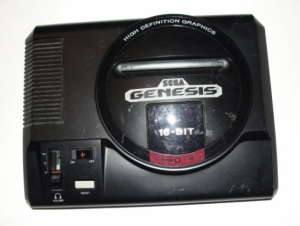
Genesis certainly was the coolest looking console of the era.
I thought I’d share my journey since it’s been a long and somewhat frustrating one. Right off the bat, I’ll tell you there are tons of options, the Sega Genesis and Master System use FM Synthesis, which tons of modern synthesizers support. You could technically create the same sounds with some of FL Studio and Logic’s native synthesizers, but it might not sound exactly like the Genesis itself.
The Genesis could also play samples. This is how most games did their drums. The super crunchy bitsmashed little samples are kind of what defined the sound of the 16-bit Sega era in my mind.
For now, I haven’t investigated native trackers – the Genesis equivalent to LSDJ might be out there somewhere but I don’t even have a console, so for now, this article is about how to get started fakebitting some Genesis sounds with some degree of realism within a DAWS like FL studio, Logic Pro or Cubase. It’s a long road to getting truly authentic, but I thought I could at least help people get started.
Genesis Trackers
My goal was to be able to compose in MIDI, not learn another tracker program. If you want to do that, you’ll want to get TFM Music Maker or the very comprehensive DefleMask. It’s actually pretty easy and similar to LSDJ and Famitracker, but I just wanted to compose in a familiar environment and end up with everything in my DAWS at the end.
Using Digital Audio Workstations to Play Back Genesis Yamaha Sounds
Check out my Battle Zone Alpha track, which I created with these tools.
VOPM – This is a pretty simple VST that emulates the Genesis’ Yamaha FM chip. You can build your own instruments by fiddling knobs, but if you’re not familiar with FM synthesis, it can be time consuming and difficult. Here’s a tutorial if you want to try it from scratch.
Getting Instrument Sounds from a Game Rom
One thing that I wanted to do right away was pull instruments from existing songs I knew on games I liked, sounds from Sonic and Earthworm Jim came to mind. There are two ways to get these loaded into VOPM.
Using the Gens KM Mod and a Neo Geo tracker called MVSTracker MD, you can dump a Yamaha channel from a running ROM and then load it up into MVSTracker, which has the same exact values and settings as the VOPM VST, then you just put the two side by side and set the VOPM VST settings to match the instrument you pulled from the game. This thread explains how to do it.
Fortunately, some wonderfully generous person took the time to pull all the instrument settings from almost any game you can imagine and put them into a format that VOPM can import. This can save you some serious time!
VOPM runs great in Cubase LE and FL Studio and I’d imagine it’ll work anywhere else you can load a VSTi. This is how I get my bass, pad and lead sounds. It’s not quite as perfect as I’d like, and I still haven’t dipped into automation, note bends and other things, but I imagine that can all be done through MIDI commands with VOPM.
Drum Sounds
I kind of feel like sampling things is cheating, but this is the quickest way to get some Sega Genesis sounding drums going within your DAWS. Just load these samples up into the sampler of your choice and you can get that classic drum sound. There are also tons of vocal samples, orchestral sounds, rock guitar bits and other things that you can use to get that classic sound.
One thing you’ll notice right away is that VOPM outputs at rather low volume levels. I bounced each track to a WAV and then loaded them all up into the DAWS and do a little EQ’ing and leveling before proceeding with normal mastering steps. Anyways, you may not be the 16-bit master by the end of this, but you can get some classic sounds without learning a new tracker from scratch. Have fun!
Quick Download Cheat Sheet
VOPM – Use this to make the melodic instruments, it’s a VST that loads up in your DAWS
Beatscribe is a full time indie composer, musician and writer. By day he creates soundtracks for various mobile gaming companies, by night creates megaman-inspired chiptunes, in the afternoons he drinks tea. Check out his latest releases, tutorials and retro ruminations at www.beatscribe.com.

 Sonic the Hedgehog is perhaps one of the most memorable and exciting games in console gaming history. As we’ve looked at the best Megaman Hacks before, I thought why not take a look at some of the amazing Sonic the Hedgehog hacks that are out there. These are just a few of the many great hacks out there for Genesis and other classic consoles. There’s even a 8-bit NES Sonic in the list!
 If you haven’t heard of